
What Online Brands Should Expect from Their Postal Boxes
What Online Brands Should Expect from Their Postal Boxes

What Online Brands Should Expect from Their Postal Boxes
Buying musical equipment online is often a carefully considered decision. A guitarist might spend weeks comparing accessories, researching replacement components or choosing the right pedals for a particular setup. By the time an order is placed, expectations have already been shaped by the retailer's product information, photographs and reputation.
The delivery experience is where those expectations meet reality.
A damaged carton, loose components or poorly secured accessories can leave a disappointing impression, even when the product itself remains usable. For independent music retailers, specialist equipment sellers and other online businesses, postal packaging is therefore more than a practical necessity. It plays a part in protecting products and maintaining customer confidence.
A well-designed postal box should perform reliably during delivery, accommodate the product appropriately and reflect the care taken by the business sending it.
Why Packaging Matters to Online Music Retailers
Music equipment comes in a remarkable variety of shapes, sizes and materials.
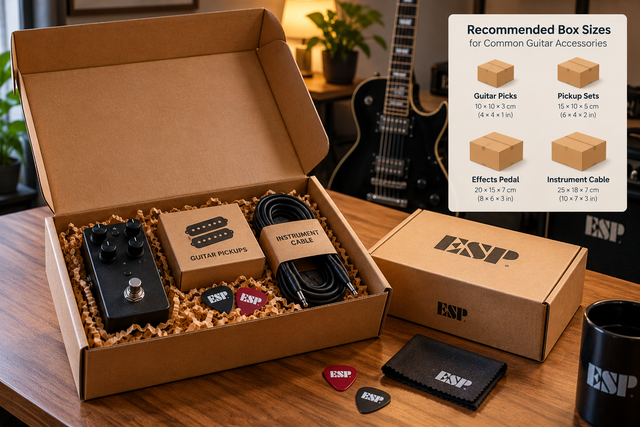
A set of guitar strings requires very different packaging from a compact effects pedal. Replacement pickups, tuning machines, instrument cables and small electronic accessories each introduce their own considerations.
For retailers supplying these products, packaging decisions should begin with the contents rather than the artwork printed on the outside.
A small guitar accessory may fit comfortably inside a lightweight carton, provided it cannot move excessively during transit. An effects pedal, however, may benefit from a stronger structure and carefully positioned protective material, particularly when its metal housing, switches and control knobs could be exposed to impact.
The same approach applies to online brands outside the music industry. The purpose is to select packaging that suits the product's physical requirements rather than relying on a single box format for every order.
Customers may never see the decisions that go into packaging development, but they experience the results when their parcel arrives.
Structural Protection Comes Before Presentation
Printed graphics and brand colours can make packaging memorable, but they cannot compensate for a poorly fitted box.
For online guitar accessory retailers, the relationship between the product, its internal protection and the outer carton deserves particular attention.
An oversized package can allow unnecessary movement, while a box that fits too tightly may place pressure on vulnerable components. Closures, board strength and internal dimensions all influence how effectively the package performs.
Consider a retailer dispatching a replacement guitar pickup. The product may be relatively small, but exposed wiring and delicate components require thoughtful handling. A properly secured inner pack can help prevent movement, while a suitable outer carton provides another layer of protection.
A compact effects pedal presents a different challenge. Its enclosure may be robust, yet protruding controls still need adequate clearance and cushioning.
This is why physical packaging samples are useful. They allow retailers to check fit, assembly and closure performance before committing to larger quantities.
For fragile or valuable goods, representative transit testing can help identify weaknesses that might not be obvious from appearance alone.
Making Better Use of Space
Packaging that is significantly larger than its contents is common in online retail.
Sometimes the additional space is necessary to provide adequate cushioning. In other cases, it reflects a limited range of available box sizes.
Music retailers often carry products with very different dimensions. A pack of strings, a guitar strap and a multi-effects unit may all require separate approaches to packing.
Using one oversized carton for everything may simplify purchasing, but it can also increase void-fill requirements and make smaller parcels unnecessarily bulky.
A practical alternative is to review the products most frequently dispatched and develop a manageable selection of packaging sizes around them.
For growing businesses, this can make packing decisions easier while helping to keep products appropriately secured.
The objective is not always to create the smallest possible package. It is to find a sensible balance between protection, material use and operational convenience.
What Protective Postal Packaging Solutions Should Deliver
For specialist online retailers, protective postal packaging solutions should be assessed according to what they actually need to accomplish.
A suitable design should help keep the product stable, support efficient packing and withstand the expected handling conditions during distribution.
For guitar accessories and music equipment, useful considerations include:
- Product stability: Accessories should not move freely inside the carton.
- Component protection: Switches, connectors, wiring and other vulnerable parts may require additional support.
- Suitable materials: Board specification should reflect the weight, fragility and dimensions of the contents.
- Secure closure: The package should remain properly closed throughout the intended delivery journey.
- Practical assembly: Staff should be able to prepare orders consistently without unnecessary complexity.
These principles also apply to other specialist online businesses, from independent electronics retailers to premium stationery brands.
Packaging performance depends on how these elements work together, rather than on any single feature.
How Packaging Supports a Consistent Brand Experience
A customer purchasing equipment from a specialist guitar retailer is looking for more than an attractive product photograph.
They expect accurate descriptions, appropriate product handling and delivery that reflects the retailer's understanding of the equipment.
Packaging can reinforce that sense of professionalism without becoming elaborate.
A restrained exterior, clearly arranged contents and a straightforward opening experience may be entirely appropriate for technical accessories.
Other brands might favour more expressive graphics, especially when their identity is closely connected to music, creativity or live performance.
For example, an independent guitar effects manufacturer may use consistent typography and visual details across its product labels, instruction cards and shipping cartons.
The result does not need to feel extravagant. It simply needs to feel considered.
Branded postal boxes are most effective when their appearance complements their functional purpose.
Excessive decorative elements can become unnecessary if they complicate handling, introduce material concerns or distract from the product itself.
Considering the Needs of Guitarists and Musicians
Musicians often develop a strong connection with their equipment.
Whether someone owns an ESP electric guitar, uses an LTD instrument for regular rehearsals or maintains a collection of accessories for live performances, the condition and reliability of their gear matter.
While full-sized guitars ordinarily require instrument-specific cases and appropriate shipping protection rather than conventional small postal boxes, many related accessories are suitable for carefully designed carton packaging.
Replacement hardware, spare parts, maintenance supplies and selected smaller accessories may all be distributed through standard parcel networks.
Their packaging should reflect the characteristics of the individual item.
A useful distinction is that packaging for a compact accessory should never be assumed suitable for shipping an entire guitar. Instrument transport involves additional considerations, including neck and headstock support, movement control and protection against external impacts.
Recognising these differences helps retailers make more appropriate decisions about their shipping arrangements.
Responsible Material Choices
Environmental considerations are increasingly relevant to packaging decisions, but there is rarely a single solution suitable for every product.
A lightweight accessory may need relatively little additional material. A fragile electronic component might require greater protection to reduce the likelihood of damage.
The important question is whether the materials chosen are appropriate for the application.
Retailers can review unnecessary empty space, excessive packaging layers and the use of components that may be difficult for customers to separate.
Board finishes, adhesives, laminates and protective inserts should also be considered when assessing how a package can be disposed of or recycled.
Recyclability claims should reflect the actual materials and the facilities available to customers, rather than relying on broad environmental promises.
For UK online businesses, clear and accurate disposal information can be a useful part of responsible packaging communication.
Reducing material use is worthwhile where practical, but not at the expense of the protection needed to deliver a product safely.
Packaging Should Work for the People Preparing Orders
The customer sees the parcel at the end of its journey. Warehouse and fulfilment teams experience the packaging much earlier.
For a specialist music retailer processing numerous small orders, efficient packing can be just as important as presentation.
Boxes should be straightforward to assemble, products should fit without excessive adjustment, and closures should be secure.
The placement of shipping labels is another practical detail.
A printed carton may look excellent in a design mock-up, but the finished layout still needs to accommodate carrier labels and any necessary handling information.
Testing the packaging under everyday fulfilment conditions can reveal problems before they become part of the regular shipping process.
Retailers should also consider how boxes are stored, selected and replenished.
An attractive design offers limited operational benefit if it is awkward to assemble or creates unnecessary handling during busy periods.
Common Mistakes Worth Avoiding
One frequent mistake is choosing packaging based primarily on appearance.
Digital mock-ups help businesses assess colours, typography and layout, but they do not demonstrate how a filled carton will perform during handling.
Another is assuming that a larger box automatically provides better protection.
Without suitable internal support, additional space can allow movement rather than prevent it.
A third issue is overlooking product-specific requirements. Packaging appropriate for strings or cleaning accessories may not be suitable for delicate electronic equipment.
It is also worth avoiding unnecessary complexity.
A box with elaborate opening features or multiple decorative components may look appealing, but these additions should have a clear purpose.
For retailers selling specialist equipment, good packaging is usually the result of practical decisions made with the product and customer in mind.
A Better Delivery Experience Starts with the Details
Online shopping has made specialist music equipment more accessible to customers throughout the UK.
Guitarists can compare accessories, explore replacement components and discover independent manufacturers without visiting a physical shop.
Yet the convenience of online purchasing also places greater responsibility on retailers to ensure that orders arrive in appropriate condition.
Postal boxes contribute to that responsibility.
When dimensions, construction, materials and protective features are carefully considered, packaging becomes a dependable part of the fulfilment process rather than an afterthought.
For retailers serving musicians and other specialist customers, that consistency matters.
Customers may remember the product they ordered more than the box it arrived in, but a well-prepared delivery still communicates something important about the business behind it.
Ultimately, the best postal packaging does not need to attract attention. It needs to protect the contents, support the people preparing the order and help deliver the experience customers were expecting.


PRICING AND SPECIFICATIONS SUBJECT TO CHANGE
Terms of Use | Privacy Policy | Contact Support
© Copyright 2026, The ESP Guitar Company, 5433 West San Fernando Road, Los Angeles, CA 90039 USA - PH: (800) 423-8388 - INTL: (818) 766-2097 - FAX: (818) 506-1378
Design by SilverFrog


